Gorton Health Matters
A community-led priority setting partnership for research
Overview
A Priority Setting Partnership (PSP) brings together patients, carers and health professionals to identify priorities for health research. Vocal worked with Healthy Me Healthy Communities (HMHC) and the James Lind Alliance (JLA) to carry out a collaborative PSP in Gorton, Greater Manchester. This was the first time that a PSP has been community-led and specific to a locality.
The “Gorton Health Matters” PSP involved over 200 people and prioritised 10 unanswered research questions that matter most to the people who live and work in Gorton. The Partnership’s outputs are now being used by local people and the project partners to inform local authorities, research organisations and health and care providers.
Our approach
The project built on an established strong working relationship between Vocal and HMHC.
HMHC staff and service users have a well established understanding of the Gorton & Abbey Hey - an area with with a vibrant community life but high indicators of health inequalities.
The Project Steering Committee included people from diverse backgrounds, Voluntary Community Faith and Social Enterprise (VCFSE) organisations, Black-led groups, public sector organisations rooted in the area, healthcare professionals, and the project leads.
To ensure inclusion and equity, the Steering Committee committed to core principles of :
Reciprocity and Power sharing: moving beyond tokenistic collaboration by spending time and effort to establish deep connections and explicitly addressing power relationships
Involvement not Extraction: involving people at every stage of the project
Fair remuneration: Everyone, even survey respondents, received payment or a gift for taking part.
The project adapted the JLA methodology by training community facilitators who then delivered project activities
Our approach was:
Step 1 – Network Building: identifying partner organisations and engagement locations by a community mapping approach with the Steering Group
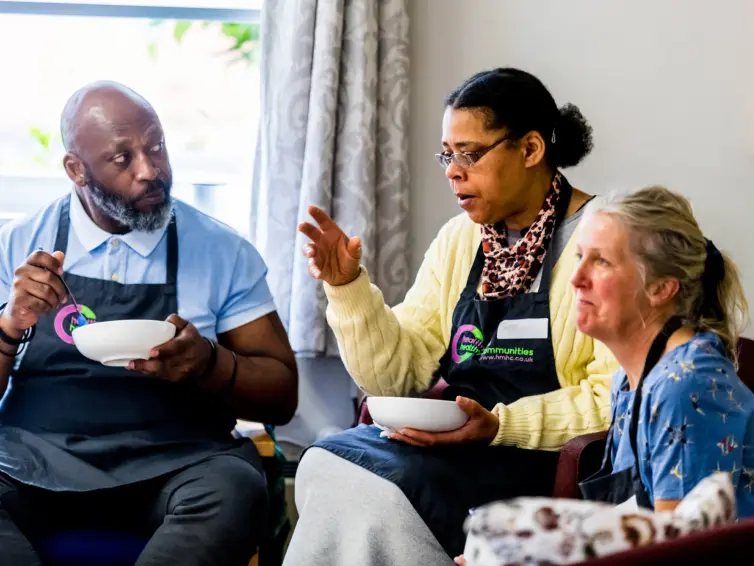
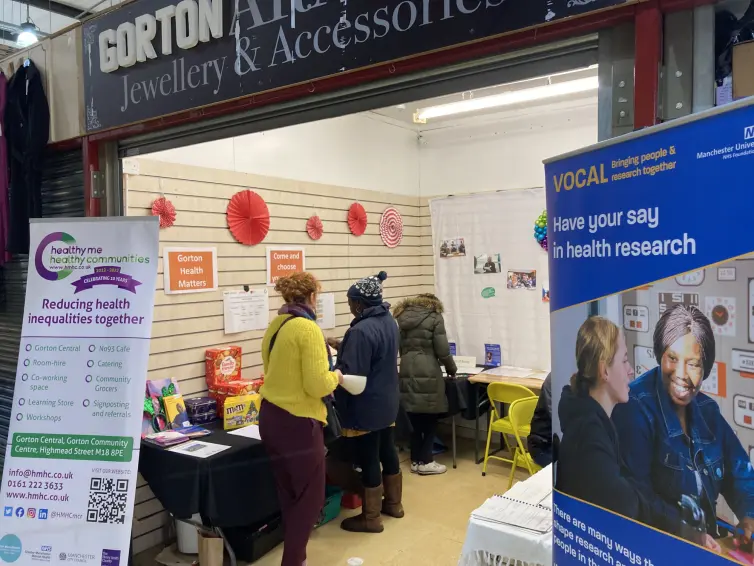
Step 2 – Community Outreach: gathering insights from 600 people about what health research matters to them. We spoke to people and ran surveys in 18 locations of high footfall and community value, including community centres, places of worship and outreach stalls at a community market. Residents with learning disabilities were engaged with specific 1:1 support, through Gorton Visual Arts
Step 3 – Analysis & Theming: collaboratively reviewing and sorting the insights from Step 1 into common themes
Step 4 – Community voting: 120 people prioritised top themes from Step 3. Voting locations included a pop-up shop in Gorton Market
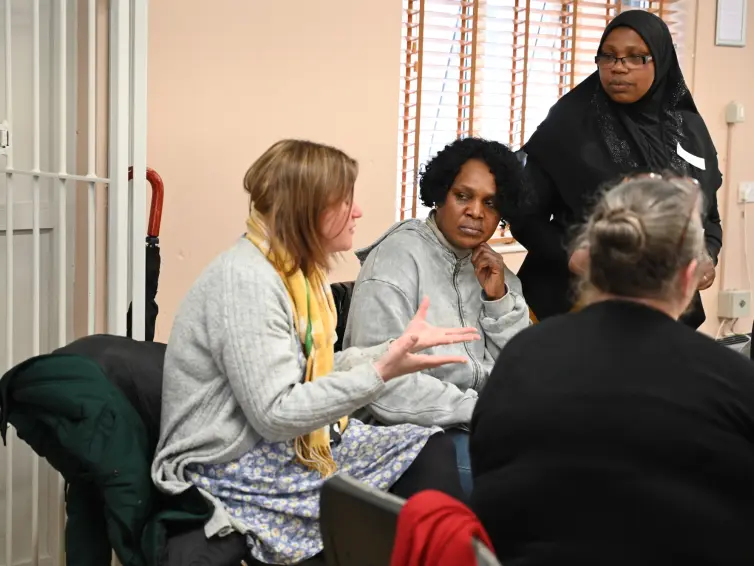
Step 5 – Finalising the Top Ten: a consensus building workshop with 40 residents, community leaders and healthcare professionals whittled down 27 priorities to 10.
In total the project engaged nearly 1000 residents and healthcare professionals,
Equalities monitoring data was collected on a voluntary basis, to ensure that the project reached a wide variety of people.
Of those who took part in outreach sessions and responded:
51% White British, 18.5% Black, Black British African or Black British Caribbean, 13% Asian or Asian British Pakistani, Indian or Bangladeshi, 3% Arab
63% female and 37% male
A wide range of ages from 18 to 83
45% Christian, 21% Muslim and 20% atheist
36% would describe themselves as having a disability
33% working, 31% retired, 19% unemployed or unable to work, 7% looking after family and 6% were students
43% had completed University education, 32% had achieved secondary education , 11% had completed Further Education, 4% completed primary education and 10% received no formal education
Activities were evaluated by feedback on the day of the activity; all participants of the final consensus workshop were asked to fill in an anonymous evaluation questionnaire.
Impact & learning
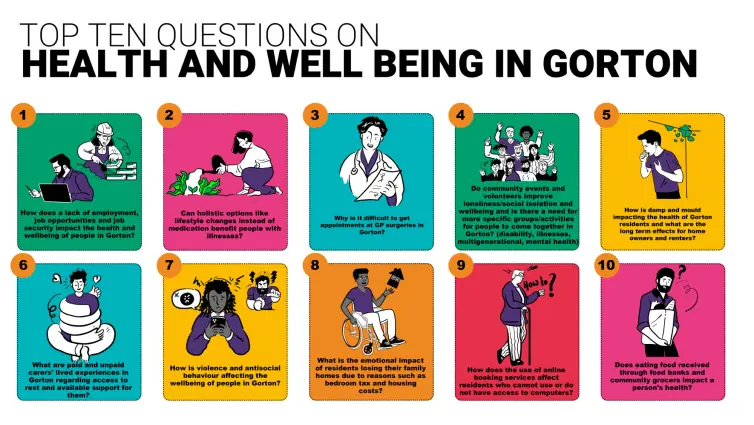
The image above shows the Top 10 Priorities identified in this project. They have been shared at HMHC events and with organisations including The Equalities Trust, Southway Housing Trust, Age Concern, Greater Manchester Ageing in Place Pathfinder.
Gorton Health Matters was highlighted as an exemplar of good engagement practice by the Research Engagement Network , and is informing next steps for the Network
The Top Ten have informed a hospital service development within Manchester University NHS Foundation Trust to provide additional care and signposting upon discharge, for patients from Gorton & Abbey Hey
We are currently working with the University of Manchester to act on the Top Ten priorities and plan collaborative research projects to address them.
The project has informed policy and practice within HMHC, Southways Housing Trust, the Equalities Trust, Age Concern, the Greater Manchester Ageing in Place Pathfinder and the organisation previously known as the Greater Manchester Council for Voluntary Organisations.
We will continue to track the use and impact of the Top Ten – this impact may take time to reveal itself.
How people felt about the Top Ten
The Top Ten were felt to be relevant
The top 10 resonate strongly with me, they feel relevant and appropriate for the times we are living in; a sense that a lot of people are currently surviving rather than thriving. We are experiencing unprecedented levels of structural inequality, the outcomes of which will only be evident in the next 10, 20, 30 years or so. The top 10 make an important contribute to the where, what and how of future research and get to the heart of what really matters.
Though a minority felt that there was nothing particularly specific to Gorton about them (perhaps reflecting on the wider health and care system, rather than the project itself)
A lot of the questions were the same questions everybody in the country would want to be asked and dealt with
Health professionals considered that many of the priority areas identified were already researched and ‘answered’, when in fact there was little formal evidence relating to these priorities (as ascertained during Step 3). This helped underline the importance and rationale for the work, and indicates clear gaps in the evidence base and understanding of the extent of the evidence base in informing current issues related to health and care in Gorton.
The adapted methodology used to arrive at the Top Ten was felt to be fair and rigorous:
Some issues within the final top 10 were not 'my top 10'. However, this is the beauty of listening and sharing opinion, and of respecting democracy.
How our approach changed engagement practice/Our unique approach
This was the first time that the JLA model of a PSP has been used in a community-led and locality-specific way.
The facilitators trained as part of the PSP continue to act as community facilitators in their day-to-day lives, including as part of subsequent health research and engagement initiatives.
This was the first time a JLA PSP had specifically signposted and enabled people involved to access other health, care and research support. As a result, the project team received narrative evidence that people were accessing health and care provision that they were not previously aware of.
As part of this work, some residents of Gorton engaged both with research and with community assets for the first time.
People valued the equitable and power-sharing approach, valuing different forms of knowledge:
It will demonstrate the value, knowledge and wisdom that often goes unnoticed, ignored or lies dormant in communities where ordinary people live and work.
The project’s approach was felt to be a useful way to support systems to use research better in the delivery of health and care
This should go a good way to influencing those holding budgets to make informed choices for necessary spending to promote change.[...] If the most important issues are being addressed this has a direct positive impact on people's health and wellbeing.
Contributing to Gorton and Abbey Hey community wealth building
People who took part grew in confidence and agency.
People became aware of their own research assets; understanding that their own lived experience was relevant to research.
Of those who responded to the evaluation:
100% would take part in similar events
100% would consider taking part in research eg. being recruited to a clinical trial
Everyone felt that the activities were accessible and that they were able to contribute
Everyone felt listened to, and confident of having a say in research as a result of being involved in the PSP activities
Community members provided feedback at the thematic analysis stage that would not have been considered otherwise
Healthy Me Healthy Communities and partner organisations learned about new forms of outreach to take forward
Acknowledgments
Gorton Health Matters was funded by the North West Research Delivery Network (previously the GM Clinical Research Network), with in-kind contributions from the National Institute for Health and Care Research Manchester Biomedical Research Centre.
Thank you to all the people from Gorton who shared what matters to them with us.